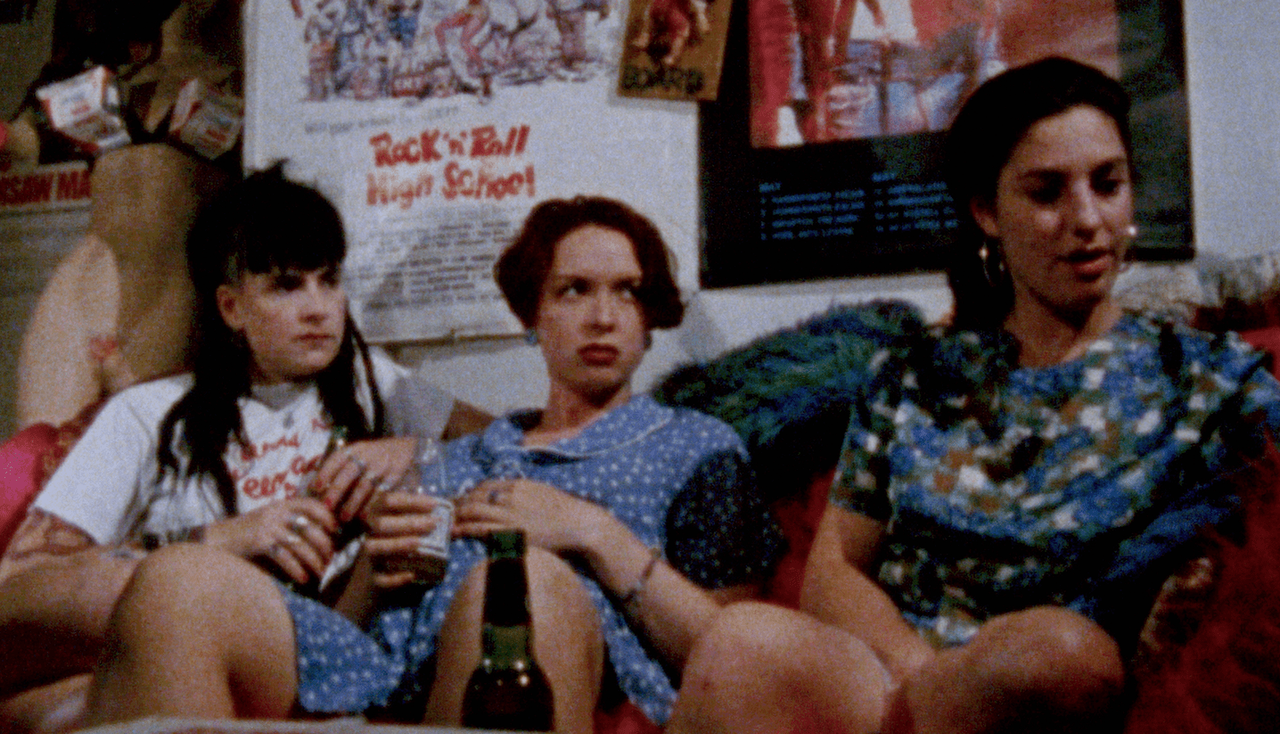
The Craft: Legacy [2020]
Dir: Zoe Lister-Jones

The film begins with Lily (Cailey Spaney) and her mother Helen (Michelle Monaghan) moving to a new town to live with Helen’s new partner Adam (David Duchovny) and his three sons. Initially an outsider, Lily soon falls in with Frankie (Gideon Adlon), Lourdes (Zoey Luna) and Tabby (Lovie Simone), becoming the long-awaited fourth in their group of witches, and Lily, in particular, sees her powers grow quickly and sometimes alarmingly.
While sticking fairly closely to the template of the original film, writer/director Zoe Lister-Jones clearly has ideas to expand the fairly basic ‘girl power’ subtext of the original. She begins by expanding the female circle that creates and exploits these powers to include a trans woman (trans actress Zoey Luna as Lourdes), but she also expands the film’s politics, dealing with questions of consent, sexuality, modern feminism, and toxic masculinity. This isn’t unique in recent horror remakes, and The Craft: Legacy does at least manage to explore its themes more organically than the recent version of Black Christmas did, and yet, a lot of the ideas remain undercooked. The one that works best is the moment that the girls cast a spell on the school’s jock bully Timmy (Nicholas Galitzine), to turn him into ‘his best self’. The studiedly politically correct guy he becomes, soon hanging out with the girls, does suffer from dialogue that seems built largely out of a woke twitter word cloud, but the point is well made and at least it shifts him from one solidly established set of character traits to another. The same can’t really be said about a later revelation about Timmy, nor about the fact that wider implications it should have on Lily’s family are never capitalized on.
This is the problem with much of the film. Ideas are suggested and either they aren’t fully developed enough (the toxicity of the masculinity in Adam’s home) or shifts in them don’t get properly developed. For instance, Helen is apparently established as a feminist, telling her daughter ‘your difference is your power’, but for me, this never squared with the sub-Stepfather tendencies the film always hints at in Adam, so I never bought into that relationship. The overall feeling is one of a film made, and particularly edited, in a rush and to a very specific set of demands. I would bet that one of those demands was an under 90-minute pre-credits running time. This was clearly a disastrous choice, as everything about The Craft: Legacy screams that there is a longer version which, even if it’s not a lot better, at least colours in some of the ideas the film as it exists simply allows to fall by the wayside, and therefore fills in a lot of the holes in the plotting and characters that make it such a frustrating watch.
While the characters could be more fully developed, Spaney, Adlon, Luna and Simone make for a watchable group of leads. Unfortunately, much of Lily’s early character development appears to have been sliced to ribbons and mixed up in an early magic montage. It’s Luna who makes the biggest impression, less because she has much more to work with than because she looks striking and Lourdes has perhaps the most forceful personality amongst the group. The group dynamic is about as well established as the truncated running time allows, and we do get a sense of their closeness, unfortunately, that doesn’t pay off quite as powerfully as it should in the film’s ending, which is another moment that seems to suffer from either budgetary or running time constraints, landing as a damp squib as a result.
It’s a pity that The Craft: Legacy isn’t a bit better. It has ideas that are timely and thoughtful, but it’s been robbed of the space to develop them into more than just vague signals of good intentions. Fans of the original are likely to find it a frustrating watch because it’s straining to give them a richer experience than the original but unfortunately falls at most of the hurdles along the way.
★★
Psychobitch [2019]
Dir: Martin Lund

Whatever the age of the protagonists, odd couples are the bread and butter of movies about relationships. It might be the very prevalence of this narrative that has led to the canard that ‘opposites attract’. The central couple of Psychobitch (an unfortunate title, but also something Marius yells at Frida after fights at the end of the film’s first and second acts) have moments when they might convince you of the truth of the cliché. These come in scenes of the two finding moments to bond, usually when Frida is able to pull the more straight-laced Marius along on her impulsive adventures, notably getting stuck in their school after hours. A sweet moment in which they look at books in the travel section of the library and say they should go to India together is one of the lighter moments of connection and happens in relatively close proximity to a much heavier conversation about why Frida recently tried to kill herself.
Tidemann and Müller Osbourne both give us layers in their work. Frida is the less straightforward character, by dint of being so unpredictable. Müller Osbourne finds playfulness in a lot of these beats, but also suggests that that flippancy is masking something deeper and more painful. Much of Marius' conflict comes from trying to figure out whether he prefers the safety of his social circle and the nice, well-liked, very much into him Lea to the live wire that is Frida. This comes through well in the story between Marius and Lea, as the film’s second act puts as much focus on his relationship with her as his growing closeness and attraction to Frida. Most notable is a sequence, first at a party and then afterwards at a sleepover at a friend’s house, when their group tries to contrive a way for Marius and Lea to sleep together. The sex, when it happens, is entirely consensual, but the scene has a sadness and an awkwardness to it because we perceive from both of them that it’s not the way either wanted it to happen.
It’s not, though, particularly easy to root for Marius and Frida’s relationship, however nice moments we see them growing closer are, and however well some of the more good-natured ribbing largely from Frida to Marius comes off. Ultimately, these two people seem much too different from each other; Frida’s problems are too pronounced and sometimes too destructive for both of them for me to fully buy into the idea that Marius is so drawn to her. One of the great strengths of Scandinavian coming of age cinema is often how true to life it feels, I think Psychobitch is trying for that and, some individual scenes aside (among them the conversation about Frida’s illness, Marius pushing his mother away when she’s trying to help and Marius trying to get Frida to talk to him after he’s upset her), director Martin Lund’s screenplay misses that target.
This is by no means a bad film. Jonas Tidemann, Elli Rhiannon Müller Osbourne and Saara Sipila-Kristoffersen are all names worth watching in the next few years, and they all bring much more than the cardboard cutout teen clichés to the table in their performances. There are extremely engaging scenes and moments that do ring true scattered throughout the film. A lovely scene of Marius and Frida literally dancing to their own beat is a slightly on the nose metaphor, but also the moment they first seem to entirely get each other, and it echoes later on in a moment I couldn’t help but smile at. The group dynamics also convince, whether it’s the class being wary of Frida or the way that Marius and his friends take the mickey out of each other about their respective levels of sexual experience. It’s just a shame that these bits that work never quite knit together, and that the main element of the story never fully convinces, despite everyone’s best efforts.
★★★